


-560x560.png)

Q&A
Customer service of CNC machine tool factories will face various customer questions in the pre-sales and after-sales stages. These questions are mainly concentrated in the dimensions of equipment selection, technical adaptation, delivery and installation, use and maintenance, fault handling, etc. The following is a detailed summary and classification of the questions:
A: The selection of CNC machine tools should be based on the core processing requirements, focusing on the following 5 points:
1) Processing Capacity (Size):
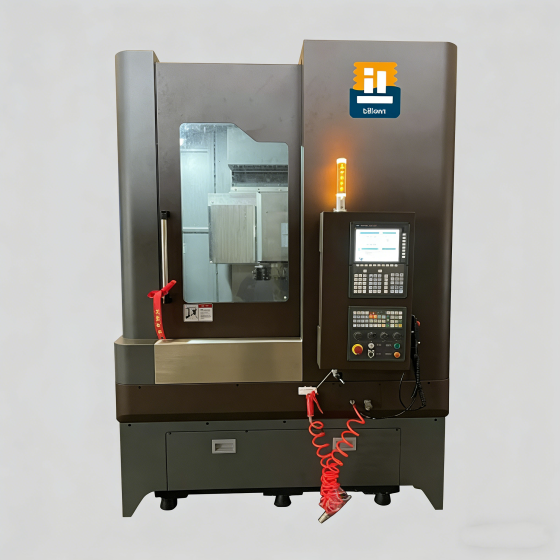
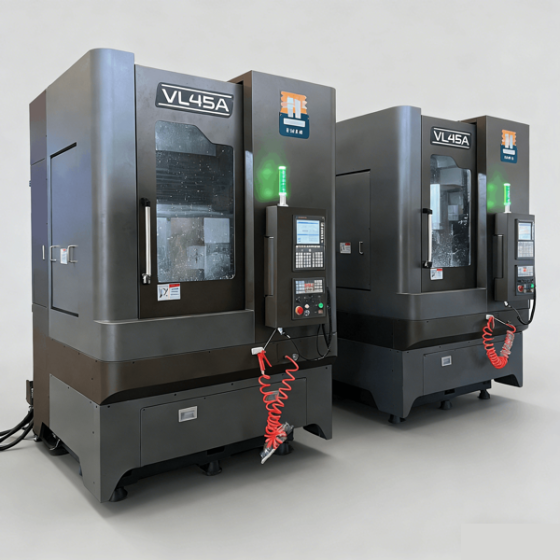
1.1 CNC Lathe - Turning (Vertical CNC Lathe, Horizontal CNC Lathe): Determine the maximum turning diameter and maximum processing length of the CNC lathe according to the length and maximum processing diameter of the largest workpiece.
1.2 Machining Center - Milling (Vertical Machining Center, Horizontal Machining Center, Gantry Machining Center): Determine the machine tool stroke (X/Y/Z axis) according to the length, width and height of the largest workpiece.
2) Processing Material: For steel processing, attention should be paid to the rigidity and spindle power of the machine tool; for aluminum processing, attention should be paid to the high-speed cutting performance.
3) Processing Precision: Economical CNC machine tools (positioning accuracy about ±0.02mm) are selected for general mechanical processing, and high-precision models (positioning accuracy about ±0.005mm) are required for precision processing.
4) Processing Batch: For mass production, priority is given to models with automatic feeding device and large tool magazine capacity (such as machining centers); for small batch and multi-variety processing, universal CNC lathes and milling machines can be selected.
5) Future Expansion: If there is a demand for expanding the processing range in the future, it is necessary to reserve redundancies such as spindle power and interface compatibility. It is recommended to provide detailed drawings and process requirements of the processed workpieces, and the manufacturer's technical personnel will provide a targeted selection plan.
A: The price of CNC machine tools is mainly affected by the following factors:
1) Core component configuration: CNC system (Imported systems such as FANUC, Siemens vs domestic systems), spindle (Imported vs domestic), guide rail (Linear rail vs hard rail, imported linear rail vs domestic linear rail) are the core factors affecting the price. The price of models with imported components is usually 30%-50% higher than that with domestic components.
2) Machine tool specifications: The larger the stroke and the higher the spindle power, the higher the price.
3) Functional configuration: The price of models with tool magazine, automatic tool change, automatic measurement, high-speed spindle and other functions will be significantly increased.
4) Brand and technology: First-line brands have higher prices than niche brands by virtue of mature manufacturing technology and quality control.
Core differences between models at different price levels:
4.1 Economical type (100,000-300,000 CNY): Mostly adopt domestic core components, suitable for general precision processing, simple functions, focusing on high cost performance, applicable to small processing plants and start-up enterprises.
4.2 Mid-range type (300,000-800,000 CNY): Core components can be imported or high-end domestic, with improved precision and stability, and basic automation functions, suitable for mass processing in medium-sized enterprises.
4.3 High-end type (Above 800,000 CNY): Full imported core components, high precision, high rigidity, high speed, with complete automation and intelligent functions, suitable for high-end manufacturing fields such as precision processing, aerospace and so on.
A: Our CNC machine tools have good compatibility, and the specific compatibility is as follows:
1) Fixture compatibility: The machine tool worktable adopts standard T-slot design, which can adapt to the mainstream bench vices, chucks, combined fixtures on the market. If the existing fixtures have special interfaces, the fixture parameters can be provided for our company to customize the adaptive adapter plate.
2) Cutting tool compatibility: The spindle interface (such as BT30, BT40, BT50) adopts industry standard specifications, which can directly adapt to domestic and imported cutting tools of corresponding specifications without additional replacement of cutting tool system.
3) Programming software compatibility: Support G code and M code generated by mainstream CAM programming software such as UG, Mastercam, SolidWorks CAM, and also support manual programming. If the existing programming files have special formats, they can be adapted through the file conversion function of the CNC system.
4) Workshop equipment linkage: The machine tool is equipped with standard RS232 and Ethernet interfaces, which can realize data interaction and linkage control with the MES system and automatic loading and unloading equipment in the workshop. It is recommended to provide the specification parameters of existing fixtures and cutting tools and the type of programming software, and our technical personnel can conduct accurate compatibility verification.
A: Our company provides full-process pre-sales technical support, including the following:
1) Demand research and scheme design: Technical personnel conduct on-site research on workshop layout, processing technology and production capacity demand, and customize machine tool selection scheme and workshop layout plan.
2) Sample trial processing: Workpiece samples can be provided to our laboratory for trial processing to verify whether the machining accuracy and efficiency of the machine tool meet the requirements, and a trial processing report is provided.
3) Technical training: Provide free pre-sales centralized training for customer operators on machine tool operation, basic programming, safety specifications and other contents.
4) Qualification and scheme docking: Provide relevant qualification documents such as precision inspection report and quality certification certificate of machine tools, and assist customers in completing project bidding and tendering, equipment procurement approval and other processes.
5) Q&A service: Assign a dedicated pre-sales technical consultant to respond to customers' various questions about machine tool performance, process adaptation, cost accounting within 24 hours.
A: The standard delivery cycle of our CNC machine tools is as follows:
1) Conventional models (such as standard stroke CNC lathe, vertical machining center): The delivery cycle is 30-45 working days.
2) Customized models (such as special stroke, special functional configuration): The delivery cycle is 60-90 working days, which is adjusted according to the complexity of customization.
3) About expedited delivery: Expedited service is supported for conventional models, and the delivery cycle can be shortened to 15-20 working days after expediting; for customized models involving core component customization, the expediting space is limited, which needs to be evaluated combined with the component procurement cycle, and the technical personnel will provide the fastest delivery scheme. It is recommended to plan the procurement time in advance. If there is an urgent production demand, you can give priority to our in-stock models to realize immediate purchase and delivery.